16 Sutras Of Vedic Maths Pdf
FUNDAMENTALS & APPLICATIONS OF VEDIC MATHEMATICS. The basis of Vedic mathematics, are the 16 sutras, which attribute a set of qualities to a number or a group. Other results for 16 Sutras Of Vedic Maths Free Download Pdf: 48,000 matched results. Showing page 1 of 10.
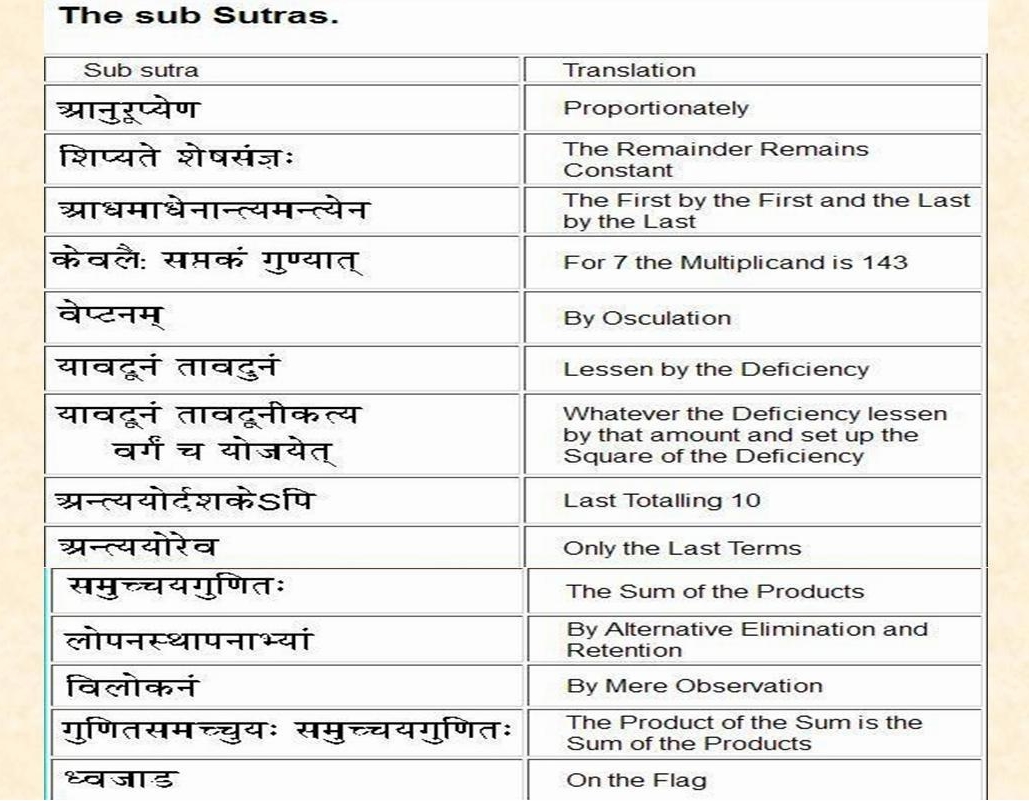
The Vedic Mathematics Sutras This list of sutras is taken from the book Vedic Mathematics, which includes a full list of the sixteen Sutras in Sanskrit, but in some cases a translation of the Sanskrit is not given in the text and comes from elsewhere. This formula 'On the Flag' is not in the list given in Vedic Mathematics, but is referred to in the text.
Sutras 1 Ekadhikina Purvena COROLLARY: Anurupyena Meaning: By one more than the previous one 2 Nikhilam Navatashcaramam Dashatah COROLLARY: Sisyate Sesasamjnah Meaning: All from 9 and the last from 10 3 Urdhva-Tiryagbyham COROLLARY: Adyamadyenantyamantyena Meaning: Vertically and crosswise 4 Paraavartya Yojayet COROLLARY: Kevalaih Saptakam Gunyat Meaning: Transpose and adjust 5 Shunyam Saamyasamuccaye COROLLARY: Vestanam Meaning: When the sum is the same that sum is zero. The Sutra (formula) Ekādhikena Pūrvena means: “By one more than the previous one”. Now let us apply this sutra to the ‘ squaring of numbers ending in 5’. Consider the example 25^2. Here the number is 25. We have to find out the square of the number. For the number 25, the last digit is 5 and the 'previous' digit is 2.
Hence, 'one more than the previous one', that is, 2+1=3. The Sutra, in this context, gives the procedure 'to multiply the previous digit 2 by one more than itself, that is, by 3. It becomes the L.H.S (left hand side) of the result, that is, 2 X 3 = 6.
The R.H.S (right hand side) of the result is 5^2, that is, 25. Thus 25^2 = 2 X 3 / 25 = 6/25=625.
In the same way, 35^2= 3 X (3+1) /25 = 3 X 4/ 25 = 1225; 65^2= 6 X 7 / 25 = 4225; 105^2= 10 X 11/25 = 11025; 135^2= 13 X 14/25 = 18225; Now try to find out the squares of the numbers 15, 45, 85, 125, 175 and verify the answers. We now take examples of 1 / a9, where a = 1, 2, -----, 9. In the conversion of such vulgar fractions into recurring decimals, Ekadhikena Purvena process can be effectively used both in division and multiplication.
Multiplication Method: Value of 1 / 19 First we recognize the last digit of the denominator of the type 1 / a9. Free Download Motogp 8 For Pc Download Layar Kaca Film Wiro Sableng. there. Here the last digit is 9. For a fraction of the form in whose denominator 9 is the last digit, we take the case of 1 / 19 as follows: For 1 / 19, 'previous' of 19 is 1. And one more than of it is 1 + 1 = 2. Therefore 2 is the multiplier for the conversion. We write the last digit in the numerator as 1 and follow the steps leftwards.
2: 21(multiply 1 by 2, put to left) Step. 3: 421(multiply 2 by 2, put to left) Step.
4: 8421(multiply 4 by 2, put to left) Step. 5: 1 68421 (multiply 8 by 2=16, 1 carried over, 6 put to left) Step. 6: 1 368421 ( 6 X 2 =12,+1 = 13, 1 carried over, 3 put to left ) Step. 7: 7368421 ( 3 X 2, = 6 +1 = 7, put to left) Step. 8: 1 47368421 (as in the same process) Step. 9: 947368421 ( Do – continue to step 18) Step. 11: 1 1 Step.
12: 1 21 Step. 13: 1 421 Step. 14: 8421 Step. 15: 68421 Step. 16: 1 368421 Step. 17: 7368421 Step. 18: 1 47368421 Now from step 18 onwards the same numbers and order towards left continue.
Thus 1 / 19 = 0.47368421 Find the recurring decimal form of the fractions 1 / 29, 1 / 59, 1 / 69, 1 / 79, 1 / 89 using Ekadhika process. The formula simply means: “ all from 9 and the last from 10” The formula can be very effectively applied in multiplication of numbers, which are nearer to bases like 10, 100, 1000 i.e., to the powers of 10(eg: 96 x 98 or 102 x 104).
The procedure of multiplication using the Nikhilam involves minimum number of steps, space, time saving and only mental calculation. The numbers taken can be either less or more than the base considered. Case (i): when both the numbers are lower than the base. Find 97 X 94. Here base is 100. Now following the rules, the working is as follows: 97 is 3 less than the nearest base 100. And 94 is 6 less than the same nearest base 100.
Hence 3 and 6 are called deviations from the base. Always the base should be same for the two numbers. = Note: Here '/' signifies just a seperation and has nothing to do with division. In genreal, let N1 and N2 be two numbers near to a given base in powers of 10, and D1 and D2 are their respective deviations from the base. Then N1 X N2 can be represented as: Case ( ii): When both the numbers are higher than the base.